HDMI Extender vs HDMI Cable: Which One Should You Use for Long Distance?
When setting up an HDMI connection, many users wonder whether they should use a standard HDMI cable or an HDMI extender.
While HDMI cables are simple and widely used, they have limitations—especially when it comes to long-distance transmission.
In this guide, we’ll compare HDMI extenders and HDMI cables to help you choose the right solution for your setup.
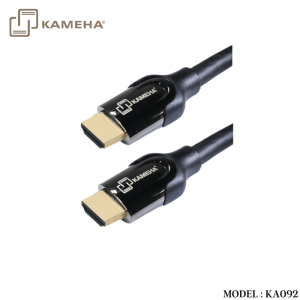
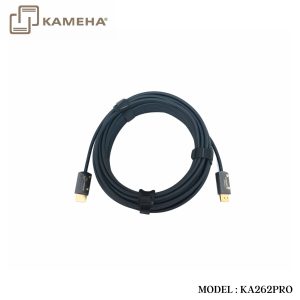
What is an HDMI Cable?
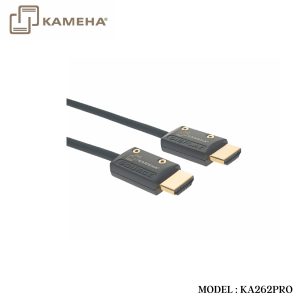
An HDMI cable is a direct connection cable used to transmit high-definition video and audio from a source device to a display.
Key Features:
– Plug-and-play, no need power supply
– No additional equipment needed
– Supports high-quality video (Full HD / 4K)
– Affordable and easy to use
Limitations of HDMI Cable
Although HDMI cables are convenient, they have distance limitations.
-Maximum reliable length typically 10–15 meters for HDMI copper non-active cable , up to 100meter for HDMI Active Optical Fiber.
📌KAMEHA HDMI cables max up to 300meters.
-Easily signal loss when joining both HDMI cables in a complex solution.
-Maintenance issue for long HDMI cables if conceal at wall or under the floor. It is not easy to be replaced if found spoilt. HDMI cables cannot been repaired as well.
-Expensive for long, high-quality cables
-Difficult to install in large spaces
📌This becomes a problem in commercial environments.
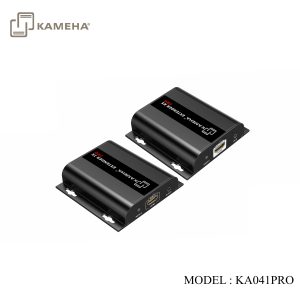
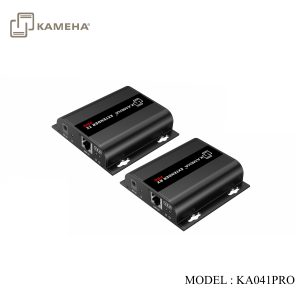
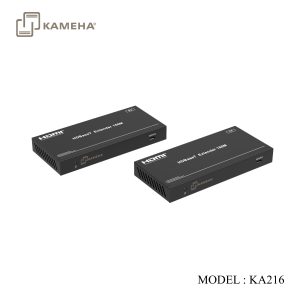
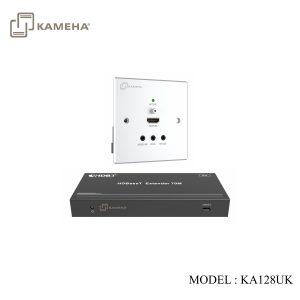
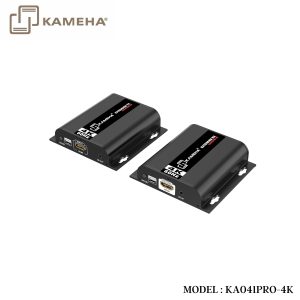
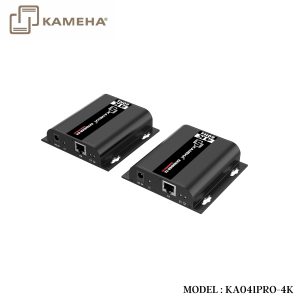
What is an HDMI Extender?
An HDMI extender allows you to transmit HDMI signals over longer distances using network cables such as Cat5e or Cat6.
It usually comes in two parts:
Transmitter (TX) – connects to the source
Receiver (RX) – connects to the display
Key Advantages of HDMI Extender
1. Long Distance Transmission
HDMI extenders can transmit signals up to 50m–100m or more, depending on the model.
2. Stable Signal Quality
Using network cables reduces signal loss compared to long HDMI cables.
3. Cost-Effective for Long Runs
Ethernet cables are generally cheaper and easier to install over long distances.
4. Cleaner Installation
Better cable management, especially in offices, retail stores, and buildings.
HDMI Extender vs HDMI Cable (Key Differences)
|
Feature |
HDMI Cable |
HDMI Extender |
|
Distance |
Short |
Long (up to 100m+) |
|
Installation |
Simple |
Moderate, need power supply |
|
Equipment |
Cable only |
TX + RX required |
|
Signal stability |
Decreases over distance |
More stable |
|
Best Use |
Home/ short distance |
Commercial / long distance |
Which One Should You Choose?
Choose HDMI cable if:
Distance is within 100meter
The installation site without power supply
You want a simple plug-and-play setup
You are using it at home or small office
Choose HDMI Extender if:
Need an easy maintenance for future
You need stable signal over long runs
You are setting up a retail, office, or commercial system
Real-World Example
Scenario 1: Home Setup
Laptop to TV (2–3 meters)
📌 Best choice: HDMI Cable
Scenario 2: Retail Shop
Player located in control room
Screens mounted across the store
📌 Best choice: HDMI Extender
Why Choose KAMEHA HDMI Solutions?
KAMEHA provides high-quality HDMI products in Malaysia, including both HDMI cables and HDMI Extenders. All products are certified HDMI products and follow HDMI.org standard.
Our solutions are designed for both residential and commercial use, ensuring stable performance and long-distance transmission.
We have various length of HDMI cables for your choice:
https://kameha.com.my/hdmi-cable-list/
Tutorial: https://youtu.be/l_2RvxClGSI
Also many different HDMI Extender to meet your needs:
https://kameha.com.my/kameha-series/
Tutorial: https://youtu.be/21IboZ34P_M
Conclusion
HDMI cables are perfect for short-distance, simple setups, while HDMI extenders are the best solution for long-distance and professional installations.
Choosing the right option depends mainly on your distance and application requirements.
Extender & hdmi cable